Vacation planning is supposed to feel like the first day of holiday. For many people it feels like unpaid project management — because it is a marathon of micro-decisions with no finish line.
You open a tab for flights. Another for hotels. A third for “best things to do.” A fourth for restaurants near the hotel you have not booked yet. By evening you have decided nothing durable — only whether to keep deciding. That drain is decision fatigue, and it ruins trips before anyone leaves home.
Here is what decision fatigue is in travel, how OTAs and inspiration feeds make it worse, and how staged commitment — wishlist first, days second, export last — restores energy without forcing a rigid tour.
What decision fatigue actually is
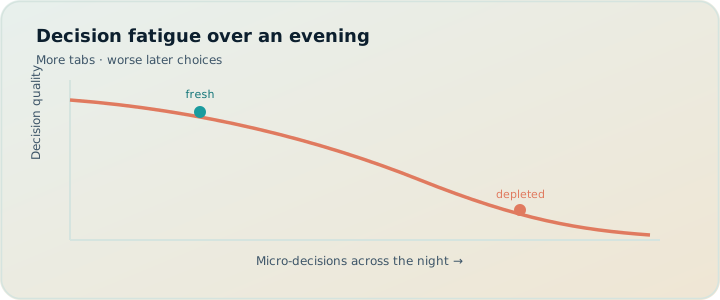
Decision fatigue is the declining quality of choices after a long session of deciding. It is not laziness. It is a predictable cognitive tax: each choice consumes attention, and later choices get coarser — more impulsive, more avoidant, or more likely to be deferred forever.
Travel triggers it hard because the decision tree is deep and poorly bounded:
- Destination and dates
- Neighborhood and lodging
- Flight times and connections
- “Must-see” lists that never stop growing
- Restaurants, rainy-day backups, and kid-friendly alternatives
- Transport mode for every hop between stops
Each choice spawns three more tabs. Worse, many of those choices are reversible in theory — so your brain never marks them as closed. You keep reopening yesterday’s almost-decision because nothing in your tools says “this is committed.”
Psychologists have long noted that depleted decision-makers default to the path of least resistance: postpone, copy a stranger’s itinerary, or let the loudest person in the group chat pick. None of those defaults reliably produce a trip you trust on the sidewalk.
Booking research has long tracked travelers across dozens of sites and hundreds of page views before purchase — ranges on the order of 141–277 page views in widely cited Expedia-era and Skift-covered clickstream work. Activity planning rarely forces a checkout, so the fatigue session never ends. Roughly 40%+ of travelers now lean on AI for some planning help; without a durable itinerary object, that help often becomes one more decision pile to reconcile.
How decision fatigue shows up on real trips
You can spot the pattern without a lab study. It looks like this:
- You postpone booking because research never feels finished
- You overstuff day one with “musts,” then burn out by Wednesday
- You outsource the final call to whoever texts fastest in the group chat
- You arrive and still do not trust the plan — so you renegotiate at breakfast
- You keep a parallel “maybe” list that never gets pruned, so every evening feels like starting over
Travel advisors market curated options for exactly this reason: a smaller search space. DIY travelers need the same idea without giving up control — fewer open loops, clearer defaults, and a place where “decided” means decided. The cost shows up mid-trip: you are still choosing when you should be experiencing.
Concrete scenario: Barcelona before the flights are booked
Two adults planning five nights in Barcelona. Night one: they compare neighborhoods until midnight — Gothic vs Eixample vs near the beach — and bookmark six apartments without picking one. Night two: they build a “musts” list in Notes (Sagrada Família, Park Güell, Picasso, beach, tapas crawl) while still undecided on lodging, so every attraction debate secretly reopens the neighborhood debate. Night three: a chatbot produces a charming three-day draft; they paste it into a Doc. Night four: they notice Monday museum closures conflict with the Doc, and also that the Doc has no travel times. By night five they are exhausted, still unbooked, and arguing about whether to “just wing it.”
Nothing in that week was a character failure. Every tool invited more deciding without a stage that closed a loop. The Doc and the chat scroll looked like progress; they were open decisions wearing the costume of a plan. Chatbots miss durable itinerary objects — they do not become a Day Planner that recomputes transit when you swap days.
Why OTAs and “best of” lists make fatigue worse
Online travel agencies are optimized for conversion, not for your cognitive load. Filters, badges, “similar properties,” dynamic prices, and endless sort options create a surface that looks helpful and feels endless. Feature overload is not a bug of the interface — it is the product. More comparison points keep you scrolling; scrolling postpones commitment.
Activity planning inherits the same disease. “Top 10 in Rome” lists disagree with each other. Maps pins multiply. TikTok saves arrive after you thought the itinerary was done. Every new option reopens the question of whether yesterday’s choices were wrong.
Booking research has long tracked travelers across dozens of sites and hundreds of page views before purchase. Activity planning is worse: no checkout forces closure, so notes apps hold infinite maybe-lists. Tools that maximize discovery without staging commitment train you to stay in research mode — productive-feeling, and where fatigue lives. Adjacent problems — choice overload and maximizing — amplify the same tax; see choice overload and maximizers vs satisficers.
The antidote is staged commitment — not fewer dreams
The fix is not “research less” or “be spontaneous.” Spontaneity without a skeleton is just another decision pile waiting at the hotel lobby. The fix is to separate stages so your brain can close loops:
- Inspiration without schedule. Collect candidates freely.
- Commitment with constraints. Assign only what fits days, hours, and pace.
- Handoff lock. Export or share so the group stops renegotiating in chat.
That sequence matches how serious planners already think — and it is exactly how TripPapa is built. Wishlist first. Days second. Warnings while you schedule. Export when the plan is ready to leave the planning brain.
Structure is not the enemy of spontaneity. Exhausted indecision is.
Wishlist vs days: stop treating every pin as a promise
Most tab chaos starts because inspiration and commitment share one list. A Google Doc of “places” does not tell you which items are dreams and which are Tuesday morning. A map full of pins looks like a plan and behaves like anxiety. For the tab-sprawl framing numbers and five-app stack, see trip planning tab chaos.
TripPapa’s Research surface is the inspiration stage. Use Search + Add to find real places, or add spots you already know. Everything lands in a filterable wishlist — the pool of candidates. Assigned stops still live in that pool conceptually; Day Planner shows where they have landed. You are not maintaining two databases that drift apart.
This separation is the first fatigue killer. You can keep adding ideas without pretending every idea is scheduled. The wishlist absorbs FOMO. The day board absorbs reality. When those two jobs share one undifferentiated list, every new save reopens the whole trip.
Practical rule: if you are still discovering, stay in Research. Do not drag half-baked ideas onto days just to feel progress. Progress in stage one is a clean, tagged wishlist — not a fake schedule. That is how TripPapa operationalizes the psychology: it gives “still deciding” and “decided for this day” different homes so working memory can release the open loop.
Day Planner: decide with constraints, not vibes
Decision fatigue spikes when choices lack constraints. “What should we do Thursday?” is an unbounded question. “What fits Thursday given our home base, transit mode, visit durations, and opening hours?” is a solvable one.
In Day Planner, you drag wishlist items onto days, set durations, and let TripPapa chain arrival and departure times with travel legs for transit, drive, walk, or cycle. The day stops being a mood board and becomes a timeline. That is when decisions get cheaper: you are choosing among feasible slots, not among infinite blogs. Deeper mechanics: Day Planner and travel times.
Two sensors matter here — and they exist specifically to spare your future self:
- Hours warnings when a planned arrival fights opening times (before open, after close, visit spans close, closed today).
- Pace warnings when visits plus travel push a day into overload territory — roughly past about ten active hours.
Those warnings do not book tickets for you. They stop the silent failure mode where the plan looks fine on paper and collapses on the sidewalk. More importantly for fatigue: they externalize conflict detection. You stop holding weekday math and transfer estimates in working memory. Working memory is exactly what decision fatigue empties.
When you assign from the wishlist, packedness previews show whether a day is light, busy, or overloaded before you emotionally commit to “fitting it in.” That preview is a decision aid: it turns “should we add this?” into “which day can absorb this?” — a narrower, kinder question. For the deeper mechanics, see opening hours and pace warnings.
Month View and Map: balance without reopening everything
Decision fatigue also comes from local optimization. You perfect Tuesday, then notice Friday is empty and Monday is a marathon. Without a trip-level view, you keep micro-editing days and never feel done.
Month View answers “is the week balanced?” Drag unassigned wishlist items onto days. Move stops between days. Swap entire days when weather or energy demands it. Draft freely, then Discard or Save & process so travel recomputes — you are not inventing a new decision tree every time you move a stop. See Month View.
Map answers a different fatigue source: geographic nonsense. Wishlist pins versus a single-day route should not live in separate apps that disagree. When the map and the day list share one workspace, you stop second-guessing whether the list is lying.
Balance and geography are constraints. Constraints reduce decisions. That is the whole point.
Export lock: why a handoff ends the thrash
Group trips amplify decision fatigue because every open loop is social. If the plan only exists as screenshots and chat threads, anyone can reopen any choice at any time. The trip lead becomes a human API.
TripPapa’s handoff tools are the commitment stage:
- Print / Save PDF — a portable artifact for grandparents, offline days, and people who will not open your planning app. See print/PDF for families.
- View-only share link — co-travellers browse Research, Day Planner, Month View, Map, and Export without editing your workspace. See view-only share.
Call this the export lock. You are not claiming the plan is perfect forever. You are claiming it is the current committed version. Renegotiation requires a deliberate edit in the planner — not a late-night “what if we swap museums?” that unravels three days of work.
Export also carries hours warnings onto day pages, so the PDF does not hide problems you ignored on screen. The handoff is honest. Honesty reduces last-minute thrash.
A practical anti-fatigue planning session
If you want a concrete loop that respects staged commitment:
- Session A (45–60 min): Create the trip. Add 8–15 wishlist places. Tag and filter. Do not schedule yet.
- Session B (45–60 min): Assign must-dos to days. Set realistic durations. Refresh travel. Fix hours and pace warnings.
- Session C (30 min): Balance in Month View. Check Map for zigzags. Cut or park leftovers back to unassigned.
- Session D (15 min): Export PDF and/or create a view-only share link. Tell the group: this is the working plan.
Split sessions beat one exhausted midnight marathon. Decision quality is higher when you stop before depletion. The product supports that because each stage has a clear “done” state: wishlist collected, days feasible, handoff published.
Optional Cloud Save and magic-link auth are for backup or another device — not a gate before the first wishlist item. Local-first planning means you can start tonight without a signup ceremony; see local-first and Cloud Save.
Step framework: five decisions to close first
When fatigue is already high, do not open a “best of” list. Close these five decisions in order — each one shrinks the next choice set:
- Party and constraints — who is traveling (ages matter), home base, preferred mode (transit / drive / walk / cycle), day start time.
- Lodging neighborhood — book or shortlist lodging elsewhere (OTA); stop reopening the city once home base is known.
- Must-dos only — three to seven items that would make the trip a failure if missed; everything else is want/maybe.
- Day themes — assign musts under hours and pace; let warnings veto fantasy stacks.
- Handoff — PDF or view-only link before the group chat gets another vote.
AI can accelerate Search + Add and auto-plan with revert inside that order — it should not replace the order. See AI trip planning in 2026.
Mistakes that keep the fatigue loop running
- Scheduling while still discovering. Fake days create fake commitments you then reopen.
- Treating every co-traveller message as a new decision. Park ideas in the wishlist; assign later under constraints.
- Using screenshots as the plan. Screenshots invite renegotiation because they are not the system of record.
- One midnight marathon. Depleted decisions are the ones you regret on the sidewalk.
- Optimizing lodging and activities in the same tab session. Sequence them; do not interleave forever.
- Expecting a chatbot paragraph to end the thrash. Without travel legs, hours warnings, and export, you still own every micro-decision.
Complementary tools — reduce decisions by job
TripPapa is not a booking engine, flight-alert product, or live multi-edit map. Hire specialists for those jobs so you are not deciding inside the wrong surface:
- OTAs / airlines — book flights and hotels once the neighborhood decision is closed.
- TripIt Pro (~$49/yr) — booking timelines and flight alerts after confirmations exist; stops re-finding vouchers in email.
- Wanderlog Pro ($39.99/year) — when friends must edit the same map live; TripPapa share is view-only.
- Maps on the day — turn-by-turn navigation; plan sequence and feasibility in TripPapa first.
Stacking complementary tools reduces fatigue when each tool owns one job. Duplicating the day list across Notes, Sheets, chat, and a chatbot is how fatigue multiplies. Broader map: Wanderlog / TripIt / Notion roundup.
What TripPapa is not claiming
TripPapa is not a booking engine and will not replace verifying critical hours on official sites. It gives DIY planners what tours sell structurally: a bounded decision space with a durable itinerary. AI (Search + Add, enrichment, auto-plan with revert) accelerates drafts inside that object — it does not replace wishlist → days → export. A chatbot paragraph you cannot share still leaves you owning the fatigue. Pricing is framed as a $35 / 6 months planning pass — oriented to a trip window, not an annual alert subscription.
FAQ
Is decision fatigue the same as choice overload?
Related but not identical. Choice overload is too many options at once; decision fatigue is depleted quality after many decisions. Travel usually delivers both. Staged commitment helps either way.
Should I plan less to feel less tired?
Plan in stages with finish lines. Less unstructured thrash, not less care. A short Session A that ends with a tagged wishlist beats an open-ended “research night.”
Can AI remove decision fatigue?
It can draft faster. Roughly 40%+ of travelers already use AI. Fatigue returns if the output is a chat scroll you must manually reconcile with hours, kids’ ages, and metro legs. Put AI inside a planner; see AI trip planning in 2026.
Do co-travellers need accounts?
No. View-only share covers browsing. You remain the editor so the group does not fork five versions.
What if we need everyone to edit live?
TripPapa’s share model is view-only. If live multi-edit is the primary need, Wanderlog Pro ($39.99/year) may fit that job better — then keep a feasibility pass in TripPapa if sidewalk math matters.
Bring the excitement back
Decision fatigue ruins vacations early because planning becomes an open-ended job with no deliverable. Close the loops on purpose. Collect freely in a wishlist. Commit under constraints in Day Planner with hours and pace as sensors. Lock a handoff so the group stops thrashing.
That is how structure returns excitement: not by removing choice, but by sequencing it.
Ready to plan without the tab hangover? Open TripPapa. For the full product loop, read How TripPapa Works.