Some travelers cannot stop optimizing. There is always one more neighborhood, one more “hidden gem,” one more restaurant with slightly better reviews. The plan improves on paper. The planner feels worse.
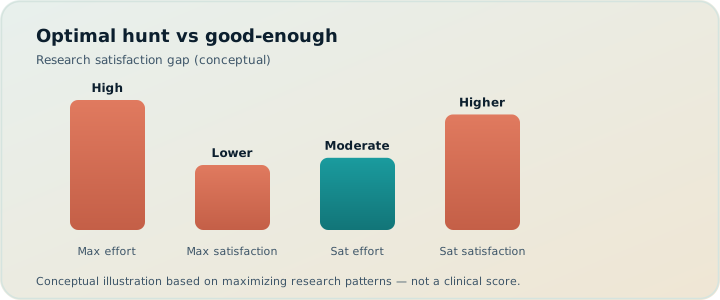
Psychology has language for that gap. Maximizers hunt for the best option. Satisficers hunt for an option that is good enough under clear standards. Research on vacation decisions finds that maximizing often correlates with lower subjective well-being (SWB) around the choice — more regret, more comparison, less peace with what you booked — even when the objective itinerary looks stronger.
This article explains the maximizer/satisficer distinction for trip planning, why “perfect” plans feel worse, how OTA-style feature overload feeds maximizing, and how TripPapa’s staged commitment (wishlist vs days, hours/pace warnings, export lock) helps maximizers behave more like satisficers without becoming careless.
Maximizing vs satisficing, without the jargon fog
A satisficer sets thresholds: “We need a walkable base, two museums, one park day, and dinners that work for a mixed-age party.” When a plan clears the thresholds, they stop. A maximizer keeps searching because a superior combination might exist — and because stopping feels like settling.
Both styles can produce good trips. The difference is the emotional overhead. Maximizers pay a tax in time and self-doubt. They are more likely to:
- Reopen closed decisions after new information appears
- Compare their itinerary to strangers’ social posts mid-trip
- Feel disappointment even when the day went fine, because a counterfactual day might have been finer
- Delay booking or delay locking the activity plan until the research feels “complete” (it never does)
Vacation research on maximizing versus satisficing matters because holidays are supposed to raise well-being. If your planning style systematically lowers SWB before and during the trip, the process is working against the point of the trip.
This is not a moral failing. Maximizing is often rewarded at work. Travel is a domain where the same habit backfires: the option set is huge, feedback is delayed until you arrive, and many attributes are incommensurable (quiet hotel vs central hotel; deep museum day vs beach day).
The same environment that trains maximizers also produces tab chaos and choice overload: booking research in the 141–277 page-view ranges, infinite “best of” feeds, and — for roughly 40%+ of travelers — AI drafts that can be re-prompted forever. Chatbots miss durable itinerary objects; every new generation restarts the hunt for the global best day. Related reading: choice overload and decision fatigue.
Why “perfect” trip plans feel worse
Perfection in travel is a moving target. New lists publish weekly. Prices change. Weather shifts. Friends send screenshots. A maximizer interprets every new input as evidence the current plan is provisional.
Subjective well-being drops for several linked reasons:
- Opportunity cost salience — every chosen stop highlights the unchosen ones
- Upward comparison — someone else’s reel becomes the benchmark
- Responsibility burden — if you insisted on optimizing, any friction feels like your failure
- Decision fatigue — long maximizing sessions deplete the quality of later choices (see decision fatigue in travel planning)
Ironically, maximizers often build denser itineraries. Density looks like competence. It also raises the odds of hours conflicts and pace collapse — objective failures that confirm the maximizer’s fear that they still have not gotten it right.
Satisficers are not anti-research. They are anti-unbounded research. They use standards and constraints as stopping rules. Stopping rules are how you protect SWB.
Concrete scenario: the third rewrite of Thursday in Kyoto
One trip lead, two adults and a teenager, six days in Kyoto. The lead is a maximizer. Version one of Thursday stacks Fushimi Inari at dawn, two temples, a craft workshop, and an evening food alley — because each item won on reviews. Version two swaps temples after a blog claims a “better” garden. Version three reorders everything after a chatbot proposes an “optimal walking loop.” None of the versions has reliable travel legs for the family’s pace. Monday-closed interiors keep getting rediscovered. The teenager is already tired of planning; the lead feels they cannot stop until the day is “right.”
What would help is not another ranking. What would help is external standards: party-aware durations, transit legs, hours warnings, pace warnings, and a published PDF that ends the rewrite loop. The maximizer’s instinct to optimize redirects toward feasibility — a criterion that can actually be met.
How OTAs and infinite feeds train maximizers
Online travel agencies and experience marketplaces are maximizing gyms. Sort by guest rating. Sort by price. Sort by distance. Open the map. Open similar properties. Watch a countdown badge. Each feature whispers: the global best might be one click away.
That interface rewards maximizing behavior and punishes satisficing. A satisficer’s shortlist looks irrational next to a tool that can always re-rank. Postponement follows. Why lock a hotel or a day plan if the assortment UI still has unexplored filters?
Activity planning inherits the same pressure. “Top attractions” lists disagree. Review sites disagree. AI chatbots will happily generate a new “optimal” day every time you re-prompt. Without a durable itinerary object, every generation restarts the maximizing loop. Feature overload does not only confuse beginners. It specifically hooks people who already believe the best option is knowable if they search hard enough. The research implication from choice overload and the paradox of variety is adjacent: more assortment can increase delay and reduce satisfaction. Maximizers live in that delay. Surface form: tab chaos.
What maximizers should optimize instead
If you cannot turn off the maximizing instinct, redirect it. Optimize the process, not the mythical global best day.
High-leverage standards for vacation satisficing:
- Party fit — ages, mobility, budget honesty
- Geographic coherence — days that do not zigzag the city for bragging rights
- Hours realism — arrive when places are open
- Pace realism — leave slack for food, wrong turns, and mood
- Handoff clarity — a plan others can follow without interrogating you
Notice what is missing: “highest average review across all possible attractions.” Reviews are inputs. They are not a stopping rule. Fit is a stopping rule.
The best trip is the one you can stop planning — and still enjoy when reality edits it.
TripPapa antidote 1: Wishlist vs days (park options without obeying them)
Maximizers suffer when every saved idea feels like an unpaid debt. A single notes list of 40 places becomes a guilt engine: if it is on the list, it must be scheduled, or the list was a failure.
TripPapa’s wishlist (Research) is where maximizers can finally over-collect without immediately over-committing. Search + Add, manual adds, tags, filters — expand freely. The wishlist is allowed to be larger than the calendar. That permission is psychologically load-bearing.
Day Planner is where satisficing happens. Assignment is the scarce resource. You are not asking “is this place excellent?” You are asking “does this place earn a slot given today?” Unassigned leftovers are not failures. They are the surplus of a healthy expansion stage.
This is staged commitment. It lets maximizers keep their research identity while forcing a satisficer’s calendar. If you only remember one product idea from this article, remember that: saved ≠ scheduled. That is how TripPapa operationalizes maximizer psychology: it separates the hunt from the commitment so SWB is not taxed by every unscheduled gem.
TripPapa antidote 2: Hours and pace warnings (external standards beat vibes)
Maximizers often override soft advice (“maybe that’s too much”) because soft advice feels like settling. They respond better to external constraints that look like facts.
Day Planner supplies those constraints:
- Travel legs between stops for transit, drive, walk, or cycle — so the day is a timeline, not a fantasy list
- Hours warnings when arrivals fight opening times
- Pace warnings when visits plus travel push toward overload (roughly past ~10 hours), with packedness labels as you assign
These warnings are permission to cut. Cutting is the skill maximizers lack — not discovering. When a day is flagged overloaded, removing a lower-priority stop is not “giving up.” It is meeting a standard. That reframe protects SWB: you optimized for feasibility, which is a real criterion, not a vague fear of missing out. Mechanics: hours and pace warnings, Day Planner travel times.
Month View helps maximizers who locally over-optimize one day and ignore trip balance. Swap days. Move stops. Draft, then Save & process so travel recomputes. Map wishlist pins versus a day route to catch geographic maximizing — the habit of adding distant “best” pins that destroy the afternoon. See Month View.
TripPapa antidote 3: Export lock (end the regret rehearsal)
Maximizers reopen plans because the plan never graduates. It stays a private draft, so every evening is another chance to improve it — which means every evening is another chance to regret it.
Export is the graduation ceremony:
- Print / Save PDF — a committed artifact for the trip lead and family members who will not live in the planner — print/PDF
- View-only share link — co-travellers can browse without creating conflicting forks — view-only share
The export lock does not ban changes. It changes the default. The default becomes “follow the published plan unless we deliberately edit.” That social contract is how groups protect maximizers from themselves and protect satisficers from endless renegotiation.
Export that still surfaces hours warnings keeps honesty in the handoff. A maximizer’s worst PDF is a beautiful schedule that cannot survive contact with Monday museum closures. Better to lock a feasible plan than to polish an impossible one.
A maximizer-to-satisficer session plan
Use this when you notice yourself on the third rewrite of the same Thursday:
- Write five non-negotiables for the trip (examples: one slow morning, one kid-primary day, no day over a packedness “busy” without consent).
- Wishlist cap — collect until N items, then stop adding for 48 hours.
- Schedule musts only — assign the non-negotiables; ignore the rest of the wishlist until those days are clean.
- Fix every hours/pace warning before adding wants.
- Add at most one want per day if packedness stays acceptable.
- Export — share the link or PDF and declare a freeze window (for example, no structural changes until three days before departure, except weather swaps in Month View).
AI auto-plan can help maximizers generate a first feasible draft quickly — then revert if it is wrong. The point is to escape blank-page maximizing. Apply is atomic; revert returns you to the pre-AI state. Use AI as a scaffold, not as an oracle that must be re-queried forever. See AI trip planning in 2026.
Cloud Save is useful when maximizing has historically meant “the plan lives on one laptop.” Backup the committed version. Do not confuse syncing with a reason to keep thrashing — local-first and Cloud Save.
Step framework: optimize these five metrics only
Give the maximizing brain a finite scoreboard. For one planning week, refuse to optimize anything else:
- Must-do coverage — every non-negotiable is scheduled once.
- Zero unresolved hours warnings on must-dos (or consciously accepted with a note).
- No day past overloaded without an explicit family vote.
- Geographic sanity — Map day mode shows a route, not a star.
- Handoff published — PDF or view-only link exists.
If a new “hidden gem” does not improve one of those five, it stays in the wishlist. That is satisficing with teeth.
Mistakes maximizers make (and how to catch them)
- Re-prompting AI for a “better” week every night — chatbots miss durable itinerary objects; you need Revert and a freeze, not infinite generations.
- Equating density with quality — pace warnings exist to challenge that equation.
- Keeping a shadow plan in Sheets — one system of record; parallel truths restart maximizing.
- Screenshot “final” versions — screenshots invite the next rewrite; export instead.
- Optimizing lodging and activities in the same session — close lodging elsewhere, then build days.
- Skipping party ages — “from $20” adult pricing is a maximizer trap that fails families; use party-aware estimates — party-aware pricing.
What satisficing is not
Satisficing is not low standards. It is bounded standards. You can care deeply about food, art, or hiking and still stop when the plan meets your thresholds and clears feasibility checks.
Satisficing is also not anti-spontaneity. Maximizers often arrive too depleted to be spontaneous; every hour is pre-claimed by the optimization project. A satisficed skeleton with slack is what makes room for the unplanned café.
And satisficing is not “ignore research.” TripPapa’s Research surface exists because good inputs matter. The difference is where research ends: in a wishlist you can leave partially unscheduled, not in an infinite obligation to schedule excellence everywhere.
Complementary tools for maximizers
TripPapa is not booking, flight alerts, or live multi-edit. Maximizers often try to make one app do every job — which creates another optimization surface. Split jobs cleanly:
- OTAs — book once shortlisted; set a timer on lodging comparison.
- TripIt Pro (~$49/yr) — flight alerts after booking; stop hunting vouchers in email as a maximizing side quest.
- Wanderlog Pro ($39.99/year) — only if live map multi-edit is the group’s real need; TripPapa share is view-only.
- Chatbots — theme brainstorming only; land keepers in Research. See AI trip planning.
TripPapa’s $35 / 6 months framing matches a planning window — useful when maximizers otherwise subscribe to annual tools they treat as endless research gyms. Job map: Wanderlog / TripIt / Notion roundup.
FAQ
Can a maximizer enjoy planning?
Yes — if the product gives expansion a home and commitment a separate home. The SWB tax comes from unbounded hunting, not from caring.
Isn’t satisficing just settling?
Satisficing is meeting pre-set standards and feasibility checks. That can be stricter than “whatever the group chat picks.”
Should I ban AI if I’m a maximizer?
No. Use AI auto-plan once for a scaffold, then Revert or edit — do not re-prompt forever as the source of truth.
How do I stop mid-trip comparison?
Publish a handoff before you leave. Mid-trip ideas go to the wishlist for a future trip, not into tonight’s renegotiation.
What if my partner is a satisficer and I am a maximizer?
Agree on the five metrics and the freeze window in writing. View-only share lets them see the plan without living in your rewrite loop.
Lower the SWB tax without lowering the trip
Maximizing vacation decisions can lower subjective well-being even when the spreadsheet looks elite. The way out is not to pretend you do not care. The way out is staged commitment: expand in a wishlist, reduce under hours and pace constraints, and lock a handoff so regret rehearsals have to schedule an appointment.
That is how TripPapa helps serious planners — including the ones who cannot help optimizing — get excited to plan and still excited to go.
Try the loop on your next trip: Open TripPapa. For the full wishlist → days → export walkthrough, read How TripPapa Works.