More options should mean better trips. Often they mean later bookings, weaker plans, and a vacation that still feels undecided on the plane. That pattern has a research name: choice overload — sometimes framed as the paradox of variety.
In 2025, work in the Journal of Travel & Tourism Marketing revisited how variety in travel contexts can backfire. The practical takeaway for planners is blunt: expanding the choice set without a commitment structure increases delay and dissatisfaction more often than it increases joy. Online travel agencies (OTAs) and infinite “best of” feeds are engineered for variety. Your itinerary needs the opposite skill — staged reduction.
This article translates that research into vacation planning behavior, shows how OTA feature overload drives postponement, and maps antidotes onto TripPapa’s wishlist → days → warnings → export loop.
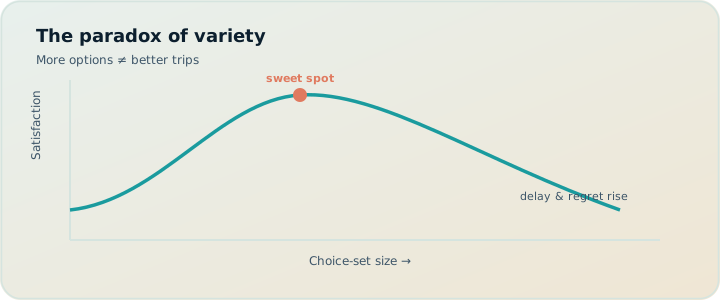
The paradox of variety, in plain language
Classic choice research showed that larger assortments can reduce purchase rates and lower satisfaction with what people eventually pick. Travel is a harsher version of the same problem. You are not choosing jam. You are choosing among cities, neighborhoods, hotels, tours, restaurants, and day sequences — often under time pressure, with partners who disagree, and with irreversible costs once flights are bought.
The 2025 Journal of Travel & Tourism Marketing conversation around choice overload and the paradox of variety matters because tourism marketing still sells “more to discover” as an unqualified good. Discovery is good. Unbounded discovery without a decision architecture is how planners stall.
Choice overload shows up as:
- Postponement — you keep researching because the next filter might reveal a better option
- Decision regret in advance — you fear missing a superior alternative you have not seen yet
- Shallow comparison — too many attributes, so you latch onto a single badge or price sort
- Abandonment — you outsource the trip to a package, a friend, or a chatbot paragraph you cannot verify
None of those outcomes require you to be “bad at planning.” They are normal responses to assortments that exceed working memory and lack a clear stopping rule.
Why vacation planning is uniquely overload-prone
Retail choice overload is often a single purchase. Vacation planning is a cascade. Destination choice changes lodging. Lodging changes neighborhood logistics. Neighborhood changes which attractions are realistic. Attractions change day themes. Day themes change restaurant windows. Every layer multiplies options.
Social proof multiplies them again. Reviews, ranking lists, and short-form video keep injecting new candidates after you thought the set was closed. The assortment is not static. It grows while you sleep.
Group travel multiplies once more. Each adult brings a private top-ten. Without a shared system of record, the merged list becomes a political document: nothing can be cut without a negotiation, so nothing gets cut. Overload becomes interpersonal.
Booking research has long shown travelers bouncing across large numbers of sites and page views before purchase — on the order of 141–277 page views in Expedia-era and Skift-covered clickstream ranges. Activity planning often never reaches a clean “purchase” moment at all. You can stay in assortment mode indefinitely. That is choice overload without a checkout. Roughly 40%+ of travelers now use AI for some planning; AI drafts can help or they can dump another assortment into Notes. Chatbots miss durable itinerary objects — a pretty list is still an open choice set until it becomes days with constraints.
Concrete scenario: Rome’s infinite “top 10”
A couple planning six days in Rome opens three “best of Rome” articles, a Maps list from a friend, and a TikTok folder of pasta places. The merged candidate set hits 35 attractions and 20 restaurants before lodging is booked. They create a Sheet with columns for rating, price, and “vibe.” Sorting the Sheet feels like progress. It is not reduction — it is assortment management. Every evening a new reel adds a row. They postpone museum tickets because the shortlist is still “incomplete.” Three weeks out they panic-book timed entries that force a zigzag day, then argue about which restaurants to cut.
The paradox of variety in action: more information lowered commitment. Nothing in the Sheet answered “what fits Tuesday under hours and transit?” so every option remained live. A chatbot “perfect Rome week” landed as another competing assortment. Without staged reduction, the internet’s gift became a delay machine.
OTA feature overload → postponement
OTAs compete on assortment and on interface power: map search, amenity filters, guest ratings, “preferred” badges, deal countdowns, flexible-date grids, and near-identical property cards. Each feature is defensible in isolation. Together they create a comparison surface that never feels finished.
Postponement is the rational-feeling response. If sort order can change the “winner,” maybe you should check one more sort. If a new filter exists, maybe yesterday’s shortlist was incomplete. Feature richness becomes a postponement engine.
The same pattern infects activity planning tools that behave like OTAs for experiences: endless cards, weak distinction between “saved” and “scheduled,” and no honest model of whether Tuesday can absorb another museum. You accumulate variety. You do not reduce it.
Marketers call this engagement. Your calendar calls it delay. Delayed decisions compress into frantic late choices — which is how overload produces both inertia and last-minute impulsivity. Decision fatigue then taxes the remaining choices; see decision fatigue in travel planning.
Variety without a reduction stage is not freedom. It is an open tab that never closes.
What the research implies for DIY planners
You do not need to memorize journal methods to use the implication. If variety can reduce satisfaction and increase delay, then good planning tools should help you:
- Expand early in a bounded inspiration space
- Reduce deliberately under constraints (time, geography, hours, energy)
- Commit visibly so the assortment stops renegotiating itself
That is staged commitment. It is the antidote to the paradox of variety in practice. Tours sell a pre-reduced set. DIY travelers need software that supports reduction without deleting curiosity.
Satisficing — picking “good enough under constraints” — beats maximizing across an infinite feed. (If maximizing is your personal habit, the companion piece on maximizers vs satisficers goes deeper on subjective well-being.)
Antidote 1: Wishlist vs days (expand, then reduce)
TripPapa separates the expansion stage from the commitment stage on purpose.
Research is where variety belongs. Search + Add pulls real places into a trip wishlist. You can filter and sort by name, category, and tags. The wishlist is allowed to be larger than the trip. That is the point. Inspiration needs a home that is not yet a schedule.
Day Planner is where reduction happens. Dragging a stop onto a day is a different speech act than saving a pin. You are saying: this earns calendar time. Unassigned leftovers can remain loved ideas without pretending they are Tuesday.
This split attacks choice overload at the root. Overload thrives when every saved item feels equally “in the plan.” When saved ≠ scheduled, you can keep discovering without reopening the whole itinerary. The paradox of variety softens because variety lives in a pool, not in a fake promise to do everything.
Practical habit: set a wishlist ceiling for the first pass (for example, 12–20 places for a week-long city trip). Add freely until the ceiling. Then switch surfaces. Further adds require cutting or parking something. Stopping rules beat willpower. That is how TripPapa operationalizes the psychology of choice overload: expansion is allowed, but commitment is a separate, scarcer act.
Antidote 2: Hours and pace warnings (constraints that cut for you)
Choice overload persists when every option still looks feasible. Constraints make infeasibility visible — and visibility is what lets you cut without endless debate.
In Day Planner, TripPapa chains arrival and departure times from day start, visit durations, and travel legs (transit, drive, walk, or cycle). Then it surfaces:
- Hours warnings — arrives before open, after close, visit spans close, or closed that day
- Pace / packedness warnings — days climbing past roughly six hours toward an overloaded zone near ten hours of visits plus travel
Those warnings are reduction tools. They answer “can we add this?” with evidence instead of optimism. Assign-to-day packedness previews show whether a day is empty, light, moderate, busy, or overloaded before you drop another must-see onto an already heavy timeline.
This is how you escape OTA-style assortment thinking. You are no longer comparing attractions only on rating stars. You are comparing them on fit. Fit is a smaller, kinder choice set. Details: opening hours and pace warnings and Day Planner travel times.
Month View extends the same idea across the trip: move stops between days or swap entire days when one day absorbed too much variety, then Save & process so travel recomputes. Map modes (wishlist pins vs day route) catch geographic overload that time math alone will miss. See Month View.
Antidote 3: Export lock (stop the assortment from renegotiating)
Even a good shortlist fails if it never becomes a shared artifact. Choice overload returns the moment co-travellers reopen the feed: “I saw another list,” “what about this café,” “maybe we should redo Thursday.”
TripPapa’s handoff is the commitment seal:
- Print / Save PDF for offline and family handoff — print/PDF itineraries
- View-only share link so others can browse the plan without forking conflicting edits — view-only share
Call it an export lock. You are not claiming omniscience. You are freezing the current reduced set as the working plan. New ideas can still enter the wishlist later — that is expansion again — but they do not automatically destabilize days until someone deliberately assigns them.
Export that still shows hours warnings is especially useful. It prevents the PDF from becoming a pretty lie. Honest handoffs reduce the social version of choice overload: endless renegotiation driven by fear that something better exists off-document.
A 2025-ready planning workflow against overload
Use this sequence when the internet feels louder than your trip:
- Name the trip constraints first — dates, party, home base, transport bias (transit-heavy vs car).
- Expand in Research only — build the wishlist; tag must / want / maybe.
- Reduce in Day Planner — schedule musts; let hours and pace veto fantasy stacks.
- Rebalance in Month View — fix feast-and-famine days; Save & process.
- Sanity-check Map — kill zigzags that survived the list.
- Export or share — publish the reduced plan; park leftovers as unassigned, not as guilt.
AI can help inside that workflow — Search + Add, enrichment, auto-plan with revert — but AI without staged commitment just generates a prettier overload. A chat scroll is another assortment. An itinerary object with days, legs, and export is a decision architecture. See AI trip planning in 2026.
Optional Cloud Save keeps the reduced plan alive across devices. It does not require you to authenticate before the first wishlist item. Local-first planning means you can start reducing tonight without a signup ceremony — local-first and Cloud Save.
Step framework: the reduce-by-half rule
When the wishlist already feels political, use a mechanical cut before you debate vibes:
- Count candidates. If over 2× the number of half-days you have, you are in overload territory.
- Tag must / want / maybe in one pass — no research tabs open during tagging.
- Schedule musts only. Fix every hours and pace warning before any want is allowed on the board.
- Add wants only into days that are still light or moderate on packedness.
- Park the rest as unassigned. Export. Declare a freeze window for structural changes.
Mechanical rules protect couples and groups from endless “but what about…” negotiations. The rule is not anti-joy; it is anti-unbounded assortment.
What not to do when variety spikes
- Do not open five more “top attractions” articles after the wishlist already exceeds your days
- Do not schedule every saved pin “just to see”
- Do not treat star ratings as a substitute for hours and travel fit
- Do not renegotiate the PDF in group chat — edit the planner, then re-export
- Do not confuse spontaneity with an unbounded choice set; leave slack on purpose, not by failing to decide
- Do not paste a chatbot week into Notes and call reduction done — chatbots miss durable itinerary objects
- Do not maintain parallel shortlists in Sheets, Maps, and chat; one wishlist is the expansion home
Spontaneous meals and bonus stops work better when the skeleton is solid. Overload steals spontaneity by exhausting the decision budget before you arrive. Tab chaos is the surface form of the same problem — trip planning tab chaos in 2026.
Complementary tools — expand elsewhere, reduce here
TripPapa is not booking, flight alerts, or live multi-edit. Use other products for expansion and logistics where they shine:
- OTAs — compare lodging and flights; close the booking once shortlisted, don’t live in filters forever.
- TripIt Pro (~$49/yr) — after bookings exist, keep confirmations and alerts out of your activity shortlist.
- Wanderlog Pro ($39.99/year) — if the group’s pain is live map editing; TripPapa share is view-only by design.
- Review sites and social — inspiration inputs; land keepers in Research, then stop scrolling.
TripPapa’s $35 / 6 months pass framing matches a planning window. Pay for reduction software when your failure mode is delay — not when your failure mode is a missing flight alert. Job map: Wanderlog / TripIt / Notion roundup.
FAQ
Does more research always make a better trip?
Not past the point where assortment exceeds your ability to reduce. The 2025 choice-overload conversation in travel marketing is a warning against unbounded variety, not against curiosity.
How big should my wishlist be?
Large enough to feel abundant, small enough to finish tagging in one sitting. For many week-long city trips, 12–20 first-pass items works; raise the ceiling only after musts are scheduled cleanly.
Isn’t cutting options the same as settling?
No — it is satisficing under constraints. Fit is a real criterion. Maximizers often need external warnings to make cutting feel legitimate; see maximizers vs satisficers.
Can AI solve choice overload?
AI can propose a shortlist quickly. If the output stays a chat scroll, you still face an assortment. Put candidates into a wishlist, reduce in Day Planner, then export.
What if co-travellers keep sending new links?
Add them to Research as maybe. Do not reopen days until a deliberate assignment session. View-only share shows the committed plan without inviting five editors.
Variety is a feature. Unbounded variety is a tax.
The 2025 research conversation around choice overload and the paradox of variety is not an argument against exploration. It is an argument against marketing “more options” as the whole product. Travelers need expansion and reduction. OTAs are excellent at expansion. Serious DIY planning needs software that makes reduction natural.
TripPapa’s staged commitment — wishlist versus days, hours and pace warnings, export lock — is that reduction layer. Use it to turn an infinite feed into a week you can actually walk.
Start reducing tonight: Open TripPapa. For the end-to-end product loop, see How TripPapa Works.