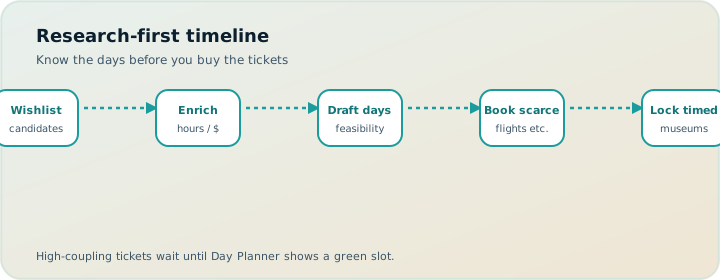
Most trip stress is purchase stress wearing a research costume. You open an OTA, half-commit to a hotel because it looked good next to a map pin you have not scheduled, buy a timed museum ticket for a day that cannot absorb the travel, then spend a week reshuffling reality around receipts. The fix is not “book earlier.” The fix is a research-first workflow: build a wishlist, test feasibility, then buy.
TripPapa is built for that order. Trips → Research → Day Planner / Month View → Map → Export / Share. Search + Add places; enrich with detail tabs (Overview, Photos, Reviews, Duration, Hours, Pricing); schedule with travel legs; heed pace/hours warnings; optional AI auto-plan with Revert; Month View Save & process; Map sanity checks; PDF and view-only handoff. Party-aware pricing for who is actually going. Cloud Save and magic link when you want backup. Pass $35/6 months. Explicitly not a booking engine, flight-alert app, live multi-edit canvas, or Discovery quiz.
Pair with when to book vs when to plan and How TripPapa Works.
Why OTA-first planning backfires
- Hotels before geography. You lock a neighborhood that fights your actual day clusters.
- Tickets before hours math. Monday closures and last-entry rules are discovered after payment.
- Party-blind buys. Child tickets and senior rates were never modeled.
- Sunk-cost itineraries. The receipt becomes the plan.
- Tab chaos. Twenty listing tabs, zero durable day database — tab chaos 2026.
OTAs and Google Travel (free dashboard) are excellent at purchasing and tracking bookings. They are not substitutes for a feasibility planner. TripIt shines after confirmations exist (Pro commonly $49/year for alert features; verify). Wanderlog (Pro $39.99/year; verify) is a planner alternative with different collab tradeoffs. Use each tool for its job.
Wishlist first. Feasibility second. Checkout third.
The research-first loop in TripPapa
1. Trips: container and party
Create the trip with dates and destination. Enter the party with ages. Set home base if you already know lodging — or set a provisional home base neighborhood pin and revise after Research clusters emerge. Defaults: transport mode, typical duration, day start.
2. Research: Search + Add without buying
Collect candidates. Filter and sort. Open Pricing for party estimates; Hours for patterns; Duration for honesty; Reviews/Photos to distinguish lookalikes. Add freely — unassigned items are first-class, not clutter. The appendix in Export later makes overflow visible on purpose.
3. Map wishlist mode: cluster before you commit money
See pins. Notice if your “musts” span three distant clusters. That insight should change lodging search — before you book the wrong Airbnb.
4. Day Planner: prove a day can exist
Drag a cluster onto one day. Refresh transit/drive/walk/cycle legs. Fix hours warnings. Respect pace warnings. If the day fails, the ticket was never the right next step. Guide: travel times, hours and pace.
5. Month View: balance the week
Unstack overloaded days; swap for weather; Save & process. Month View, shoulder season.
6. Only then book
Official attraction sites and OTAs for the stops whose days survived feasibility. Lodging near the clusters Map revealed. Flights when the date range is stable enough. Then organizer tools for confirmations.
7. Handoff
Export PDF; view-only share for co-travellers. PDF families, view-only share.
| Stage | Do | Don’t |
|---|---|---|
| Wishlist | Search + Add widely | Buy tickets for unscheduled ideas |
| Cluster | Map wishlist mode | Pick hotel from a single viral pin |
| Feasibility | Day Planner legs + warnings | Assume blog order works |
| Balance | Month View Save & process | Freeze a PDF of a draft mess |
| Purchase | Official/OTA for survivors | Let receipts design the week |
Scenario: Rome without prepaid regret
Wishlist: Colosseum, Forum area, Vatican, neighborhood walks, a day trip maybe. Map shows Vatican and Colosseum as separate energy days. Day Planner proves Vatican needs a dedicated morning with transit from home base and a short afternoon — not three other paid stops. Month View keeps a rest buffer. Then buy timed entries for the days that worked. PDF to parents. Estimates from Pricing informed the budget talk earlier — party costs — without pretending to be invoices.
Scenario: “we already booked the hotel”
Sometimes lodging is fixed (points hotel, family apartment). Research-first still applies to attractions. Set home base to the known lodging, rebuild clusters around it, and let impossible cross-town days die in Day Planner before tickets. AI auto-plan can try a draft from the wishlist; Revert and tune. The hotel is a constraint, not a reason to skip feasibility.
Scenario: group chat pressure to book now
Friends spam OTA links. Appoint one editor in TripPapa; share view-only so everyone sees the wishlist and days without forking. Book only stops that survive scheduling. If the group demands live multi-edit, that is a different product bet (e.g. Wanderlog collab) — TripPapa stays single-editor by design. vs Wanderlog.
What belongs in the wishlist vs what to buy early
Stay on wishlist longer: flexible museums, food halls, neighborhoods, viewpoints, optional day trips.
Buy after feasibility but possibly early: timed mega-attractions, popular restaurants with long lead times, limited seasonal experiences — once their day slot is real.
Often book on a parallel track: long-haul flights and peak lodging when market risk dominates — still use Map clusters to inform neighborhood choice first when you can. Nuance in book vs plan.
AI without Discovery-quiz theater
TripPapa does not run a swipe Discovery quiz. Search + Add and optional auto-plan keep you in charge. Chatbots can brainstorm names; they should not skip Day Planner validation. AI trip planning 2026.
Spreadsheets as research dumps
Early Sheets lists are fine. Migrate serious candidates into Research so Hours/Pricing/geo exist. Excel trip planning, beats spreadsheets.
FAQ
Isn’t booking early always safer?
For scarce timed entries and peak lodging, earlier can be wiser — after a feasibility sketch, not before any sketch.
Can I use Google Travel during research?
Yes for inspiration and later booking dashboards. Keep the day database in TripPapa.
Do share links let friends add places?
View-only — they browse; you add. Collect suggestions via chat, then Search + Add yourself.
What if Pricing estimates are wrong?
They are estimates. Verify official sites at purchase time.
Should I PDF before booking?
A draft PDF for alignment is fine; mark it draft mentally; re-export after bookings change times.
Does Cloud Save matter pre-booking?
Helpful backup while researching across devices; not required to start.
Pass?
$35 / 6 months — confirm in-app.
Japan-specific?
Transit feasibility before JR/day tickets mindset — Japan transit planning.
One-week research sprint
- Day 1: trip + party + provisional dates.
- Day 2–3: Search + Add 15–25 places; enrich hours/pricing on top candidates.
- Day 4: Map clusters; adjust provisional home base neighborhood.
- Day 5: schedule two proof days with legs.
- Day 6: Month View balance; Save & process.
- Day 7: decide what to book; export/share for alignment; checkout only survivors.
Buyer criteria if you are still choosing tools: good trip planner 2026. Road trips differ: road vs city.
Research quality bars before money moves
Not every wishlist item deserves enrichment. Use a quality bar: if a place is in the top half of candidates for scheduling, fetch Hours and Duration; if it is likely paid for your party, fetch Pricing; if two places look identical in memory, use Photos/Reviews tabs to separate them. Leave long-tail curiosities unenriched until they survive Map clustering. This keeps Research fast without turning Search + Add into a completionist trap.
Quality bar for lodging research: do not open OTA filters until Map wishlist mode shows where your days want to live. Then search hotels inside that geography. Booking a charming place in the wrong cluster is how research-first dies after one impulsive checkout. Google Travel can help compare options once the cluster is known — it should not define the cluster.
Social proof without letting Instagram schedule your legs
Social posts are fine wishlist inputs and terrible Day Planner inputs. Capture the place via Search + Add, then make it earn a day slot through travel math. If the viral spot sits alone far from other pins, it becomes a dedicated half-day or it goes to the appendix. Party-aware pricing may also reveal that the viral experience is a poor value for your ages — a planning signal before a cart.
Friend recommendations get the same treatment: add, enrich, schedule test, then book. Friendship does not rewrite metro transfers. View-only share can show friends you took their suggestion seriously without letting them drag it onto an impossible Tuesday.
Risk classes of purchases
Classify potential purchases before Phase C checkout energy hits:
- High scarcity / high regret if wrong day: timed mega-attractions — require green feasibility.
- High scarcity / low itinerary coupling: long-haul flights — book when dates are stable enough; still inform dates with wishlist density.
- Medium scarcity: popular restaurants — book after you know the evening’s neighborhood.
- Low scarcity: flexible museums — often wait.
- Refundable holds: sometimes useful bridges; still do not skip feasibility if cancellation is annoying.
TripPapa helps you see itinerary coupling. OTAs help you see scarcity and refund rules. Confusing those information types is how people buy nonrefundable tickets for impossible days.
Research sprints for short-notice trips
Not every vacation has a leisurely month of planning. For a sudden long weekend, compress the loop: same evening Search + Add ten places, Map cluster, schedule both days with legs, fix warnings, book only what the proof requires, Export a one-sheet PDF. Skip AI auto-plan if it slows you; or use it once and Revert if messy. Short-notice is not an excuse for OTA-first — it is a reason to be even stricter about proof days, because you lack time to repair receipt-driven plans.
Pass economics may not matter for a single surprise weekend; product access rules are in-app. The workflow still stands.
Signals you are ready to open the booking tab
You can state home base neighborhood and why. You can show a Map cluster. You can walk through Day 1 leave time and first leg without guessing. Hours warnings on must-dos are cleared or consciously accepted. Party estimates informed the budget talk. Co-travellers saw view-only or PDF and did not explode the premise. Then open Google Travel/OTAs/official ticket sites. If those signals are missing, more Research and Day Planner time is cheaper than customer-service cancellations later.
When you do book, return to TripPapa to attach reality: reservation times in notes, duration tweaks, refreshed travel. The planner remains canonical. Confirmations can also flow to TripIt for organizing — book vs plan, vs TripIt.
Wishlist hygiene: tags, kills, and promotions
Wishlists rot when nothing ever leaves. Weekly hygiene: kill places that failed Map clustering or hours reality; promote places that survived a proof day into “book when ready”; keep a small appendix of true extras. Tags like neighborhood, indoor/outdoor, paid/free, and energy-high/low make Month View swaps saner later. TripPapa’s filter/sort helps you see the pool; you still apply editorial judgment.
Promotion is not purchase. A promoted stop still needs an official checkout after feasibility. Demotion is kindness — it prevents ghost obligations that haunt family chats (“but it was on the list”). Export’s unassigned appendix should be intentional leftovers, not a graveyard of guilt.
If AI auto-plan keeps resurrecting killed ideas from unassigned items, remove them from the trip wishlist entirely or Revert and manually constrain the draft. The research-first workflow includes deletion, not only addition. Addition without deletion is how OTA tabs multiply in disguise.
Cross-check with buyer criteria when tool-switching temptation hits mid-research: good trip planner 2026. Stay in the loop you chose long enough to finish one proof week.
Common mistakes that fake “research done”
- Wishlist equals booked. Adding a place is not a reservation. Keep Research and checkout mentally separate until Day Planner says the day can exist.
- Enriching everything. Fetching Hours and Pricing on forty curiosities burns the week. Enrich survivors of Map clustering first.
- One viral pin as lodging strategy. A single Instagram location is not a neighborhood plan. Wait for clusters.
- AI draft as purchase list. Auto-plan is a distribution scaffold with Revert — not a shopping list. Fix legs and hours before money moves.
- PDF of a wishlist dump. Export after proof days exist; otherwise relatives treat unassigned appendix noise as promises.
- Parallel “real plan” in chat. Screenshots of OTA hotels become competing truth. Keep the canonical day database in TripPapa; use view-only share for visibility.
These mistakes feel productive because they produce artifacts — tabs, receipts, pretty PDFs. Feasibility is the only artifact that prevents ticket-gate regret. Related: tab chaos, decision fatigue.
Worked example: Lisbon long weekend research-first
Friday night: create trip, enter party (two adults), provisional home base near Baixa/Chiado for transit access, Search + Add twelve candidates (miradouros, Belém, Alfama walk, one museum, time-out market, day trip maybe). Saturday morning: Map wishlist mode shows Belém as its own energy block; miradouros cluster nearer the center. Schedule Saturday as center hills with walk/transit mix and earlier end; Sunday as Belém with transit legs from home base. Fix any hours warnings on the museum. Month View is short but still useful to keep Sunday lighter if Saturday is stair-heavy — Save & process after any swap. Saturday afternoon: share view-only with partner; Export a draft PDF. Only then buy a timed entry if needed and shortlist hotels inside the cluster Map revealed. Google Travel helps compare lodging once geography is known. TripIt can wait until confirmations exist.
What you did not do: buy Belém tickets for a day that also tries three miradouros across town. That is the whole method.
Worked example: family Orlando-adjacent park + city hybrid
Park days destroy pace budgets. Research-first still applies: wishlist park days as dedicated blocks in Month View; city/museum ideas stay unassigned or on recovery days. Party-aware Pricing informs the money talk for paid attractions outside the parks. Do not let OTA “attraction bundles” schedule your recovery afternoons. After proof days exist, buy park tickets on official channels for the dates Month View protected. PDF leave times matter more than a collage of confirmation emails when grandparents meet you at a gate — parents and seniors, PDF for families.
| Mistake | Symptom | Research-first fix |
|---|---|---|
| Hotel before clusters | Cross-town every morning | Map wishlist → then OTA search |
| Ticket before hours | Closed-door prepaid day | Hours tab + Day Planner warnings |
| Party-blind cart | Budget shock at gate | Pricing + party roster first |
| Chat as itinerary | Three competing Tuesdays | View-only share + one editor |
| AI paste to checkout | Impossible transfer chain | Auto-plan + Revert + leg refresh |
Step-by-step: first proof day in under 90 minutes
- Open TripPapa; create trip; enter party ages; set provisional home base.
- Search + Add eight places you already care about — no OTA tabs yet.
- Open Pricing and Hours on the three likeliest paid stops.
- Switch Map to wishlist mode; note clusters; adjust home base neighborhood if needed.
- Build one day in Day Planner; set leave time; refresh transit/drive/walk/cycle legs.
- Clear or consciously accept hours/pace warnings.
- Optional: AI auto-plan for remaining wishlist; Revert if it fights clusters.
- Export a draft PDF; create view-only share for co-travellers.
- Write a three-line booking list of survivors only.
- Now open official sites / Google Travel / OTAs for that list — nothing else.
If step 5 fails, you just saved money. That failure is the product working. Cloud Save when you want the research backup across devices; magic link when you switch machines. Pass is $35/6 months — confirm in-app when you need the planning window.
How this fits the rest of the stack
Research-first does not mean TripPapa replaces every travel product. After survivors are booked, TripIt (Pro commonly $49/year; verify) can organize confirmations and flight alerts. Google Travel stays a free dashboard for deals and booking folders. Wanderlog (Pro $39.99/year; verify) remains a planner alternative if your group requires live multi-edit — TripPapa share stays view-only by design. Spreadsheets keep ledgers. Road-shaped corridors may still want Roadtrippers. The rule is simple: do not let any of those tools become the day-feasibility database before a proof day exists. More on lanes: when to book vs when to plan, Excel trip planning, How TripPapa Works.
Hotel search after clusters: a concrete sequence
After Map wishlist mode shows your center of gravity, write three lodging constraints: transit access, noise tolerance, and max walk to the first morning cluster. Only then open Google Travel or an OTA with the map centered on that gravity. Compare three candidates max — choice overload is a booking-phase disease. Drop the winner into TripPapa as home base. Rebuild Day 1 legs from that home base before you buy any timed attraction for Day 1. If legs look ugly, change lodging while it is still a hold, not after nonrefundable tickets exist.
This sequence feels slower than “sort by guest rating.” It is faster than relocating your entire itinerary around a viral hotel in the wrong district. Research-first is geographic humility dressed as process.
Protect the plan from the shopping cart
OTAs are optimized to close. Planners are optimized to keep Tuesday possible. Do research in TripPapa until a day can survive travel legs and hours. Then buy with confidence. Your future self at the ticket gate will not thank you for an early receipt that fought geography.
Ready when you are: open TripPapa, add ten places before you open an OTA tab, and schedule one proof day end-to-end.